
Ford Fathom: The Affordable Electric Truck Comes Into Focus
The name and $28,350 price made the headline. What we saw at Ford's EV development center helps explain how the company hopes to get there—and why the unanswered questions matter differently in Hawaiʻi.
The truck we glimpsed now has a name
Ford's next electric vehicle now has a name, a price and a much clearer mission. The Ford Fathom will be a midsize electric pickup and the first production vehicle based on Ford's Universal Electric Vehicle Platform. Ford says it will start at $28,350 with a Standard Range battery, provide more passenger space than a Toyota RAV4, and include both a pickup bed and a front trunk. Every Fathom will be BlueCruise-capable, include bidirectional power capability, have Phone as a Key, and have a 15.4-inch center display. Pre-orders are planned for early 2027, with customer deliveries beginning in fall 2027.
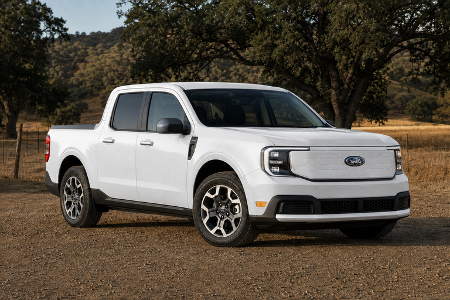
AI-generated concept rendering. Created to illustrate approximate vehicle class and proportions from the project brief. Unannounced production-design details are speculative. This is not an official Ford image and is not intended to predict the final design.
That price may be the most consequential part of the announcement. Fathom is not merely inexpensive compared with other electric pickups; it enters the price territory of ordinary compact cars and small gasoline pickups without sounding like a deliberately stripped-down price leader. When I visited Ford's Electric Vehicle Development Center in Long Beach in April, much of what we saw concerned a deceptively simple problem: how do you take cost out of an electric vehicle without simply removing desirable features? Ford's answers included radically simplified manufacturing, fewer parts and fasteners, shorter wiring, consolidated electronics, and a new Assembly Tree production system. Fathom will be the first production test of whether those ideas work at scale.
That makes Fathom more than a new model. It is the first public product of the EVDC process we saw taking shape. The truck deserves attention not because it is the best thing since sliced bread, and not because every specification is already persuasive—we do not yet have many of the specifications that matter most—but because Ford is trying to make affordability the result of engineering and manufacturing discipline.
What Ford has confirmed and what it has not
The confirmed foundation is substantial: a five-passenger-class midsize electric pickup, built at Louisville Assembly Plant on the Universal Electric Vehicle Platform and assembled through Ford's new Assembly Tree process. Ford has announced the $28,350 starting MSRP for the Standard Range version, the RAV4-plus passenger-space claim, a bed and frunk, the 15.4-inch display, Phone as a Key, BlueCruise-capable hardware, and bidirectional-power capability. Timing is pre-orders in early 2027 and first deliveries in fall 2027.
The missing list is at least as important. Ford has not yet announced EPA range, usable battery capacity, charging curve, 10-to-80-percent DCFC time, motor layout, AWD availability, towing, payload, bed dimensions, frunk volume, detailed bidirectional-power output, BlueCruise subscription terms, Hawaiʻi allocations, or an actual delivered price here. Horsepower and zero-to-60 time are also unknown, although neither would lead my list of questions for this truck.
While not yet confirmed, the Fathom is likely to be powered by the U.S.-assembled prismatic LFP cells now rolling off the lines at BlueOval Battery Park Michigan. If that proves correct, the prismatic LFP architecture would offer some useful real-world advantages over NCM battery packs in Hawaiʻi.
Even the words Standard Range invite a carefully labeled inference. Ford could simply have said that Fathom starts at $28,350. Naming the battery Standard Range strongly suggests that a longer-range option is planned. An Extended Range—or otherwise longer-range—Fathom is therefore a reasonable expectation, but Ford has not confirmed its name, capacity, range or price. That distinction between a reasonable inference and a released specification matter.
A $28,350 truck!
The cleanest comparison is not another premium electric pickup. It is the rest of the roughly $25,000-to-$30,000 vehicle market. Toyota lists the 2026 Corolla from $23,125; a better-equipped Corolla XSE reaches $28,840. Ford lists the 2026 Maverick XL from $27,145 and the XLT from $29,645. Slate's intentionally minimalist two-seat Blank Slate electric pickup is $24,950. All of these are starting MSRPs before destination, taxes, registration, options and other charges, and they describe very different vehicles.
The point is not that a Corolla, Maverick, Slate and Fathom are interchangeable. It is that shoppers may soon compare a five-passenger electric pickup with a bed, frunk and considerable standard technology against ordinary cars and compact trucks rather than deciding whether to pay a large EV premium. That is a healthier competitive environment for electric vehicles.
Slate and Fathom also offer an illuminating contrast. Slate pursues affordability through deliberate minimalism: two seats, simple equipment, no built-in giant touchscreen and an extensive catalog that lets the owner add what is wanted. Fathom appears to pursue affordability through manufacturing simplification, platform commonality and reduced complexity while retaining a more conventional level of equipment. Both approaches are interesting. The larger story is that manufacturers may finally be competing to build genuinely affordable EVs instead of ever more expensive premium ones.
Cutting cost, not usefulness
At the EVDC, the recurring philosophy could be reduced to a familiar engineering maxim: the best part is no part. Fewer components mean less material, less weight, fewer suppliers and failure points, and fewer assembly operations. Fewer fasteners and shorter hoses or cables do not produce a glamorous press-release specification, but the savings accumulate throughout the vehicle.
That is the important bridge between what we saw in April and the $28,350 number. Ford appears to be attempting to remove complexity and manufacturing cost from the truck rather than reaching the headline price only by deleting customer-facing equipment. We will not know whether the calculation works until Ford builds the Fathom in volume, holds the price, and delivers acceptable quality. But the price is at least connected to a coherent engineering story.
The factory is part of the product
A conventional vehicle moves along an assembly line while parts and systems are progressively added. Ford's Assembly Tree instead builds major portions of the vehicle simultaneously—front, center/battery/passenger structure and rear—and brings those large assemblies together later. In Tesla-speak, readers may think of structural battery-pack concepts, large castings or 'gigacasting,' although Ford's process and terminology are its own and should not be treated as a copy-and-paste of Tesla's factory architecture.
The center structure we saw was essentially the passenger compartment, floor and battery enclosure, with separate front and rear assemblies. Parallel work can shorten the line, reduce factory space, and simplify how people and parts move through production. The buyer does not need to become fascinated by plant layout. The reason it matters is that Ford believes the method can reduce labor, parts and capital cost per truck—and those savings are part of the path to $28,350.
Attention to detail
Modern vehicles can contain enormous wiring harnesses connecting dozens of electronic modules. Ford's new zonal architecture consolidates computing and places local controllers near the systems they serve. During our visit, we were told that the architecture eliminated approximately 4,000 feet of wiring and 22 pounds compared with Ford's previous approach.
Twenty-two pounds alone will not transform range. It does mean less copper, less cost, less assembly complexity and slightly less energy needed to move the truck. Add shorter wiring to fewer fasteners, fewer modules, simplified structures and reduced plumbing, and the accumulated savings become the story. We specifically asked whether the low-voltage system would be 12 or 48 volts and did not receive a definitive production answer. Until Ford confirms it, that remains an engineering question, not a specification.
What kind of truck is it?
Ford calls Fathom midsize. Our April observations of the camouflaged prototype suggested a more nuanced description: think a larger Maverick or small, midsize pickup, not electric Ranger. It appeared larger than a Maverick and smaller than a Ranger, relatively broad, with a crew-cab-dominant shape and a short bed. The packaging looked optimized for passenger room and everyday usefulness rather than traditional long-bed proportions.
The Fathom may be slated for both roles. Current evidence points most clearly to a multipurpose or lifestyle pickup with real utility, rather than a traditional work truck. Ford is emphasizing passenger space, price, technology, the frunk and the bed—not towing, payload or fleet capability. The missing specifications could change that assessment. Standard Range, a possible Extended Range model, AWD and higher configurations could plausibly span both every day and work-oriented roles, but Ford has not confirmed those variants or capabilities.
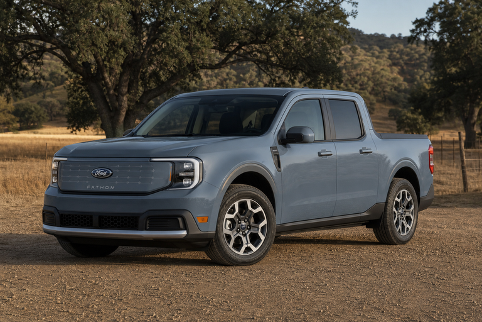
AI-generated Fathom concept. The image is an editorial visualization, not Ford photography or a representation of confirmed production styling.
That may disappoint those of us who still want an electric Ranger. I am probably not the center of Fathom's target audience. But Ford may have made the stronger business decision. The potential buyers include compact-SUV shoppers, Maverick buyers, first-time EV owners and people who were not shopping for a pickup until a practical vehicle with a bed appeared near $30,000. The RAV4 passenger-space comparison matters because it tells those buyers that the cab should not be an afterthought.
Hawaiʻi is not one EV market
National discussions often treat range as though every driver faces the same geography. We don’t. On Oʻahu, typical distances are comparatively short, population and charging are concentrated, and home charging can make a modest battery entirely practical. For many Oʻahu households, Standard Range may be the value choice rather than a compromise.
Hawaiʻi Island presents a different story. We have longer driving distances, major elevation changes, dispersed population centers, and long stretches with limited fast-charging alternatives. If Fathom does use LFP chemistry as expected, that chemistry would offer some advantages for Hawaiʻi. LFP generally tolerates routine charging to 100% better than NCM batteries, potentially allowing owners to begin ordinary daily driving with more of the battery's rated range available without the same longevity concerns. That's especially useful on Hawaiʻi Island, where distances are greater and public charging remains sparse. And one of LFP's traditional weaknesses (cold-weather performance) isn't much of a handicap in our remarkably mild climate. For Kona-Waimea-Hilo driving, additional range is not merely a bragging number. It provides operational flexibility and redundancy when the charger one hoped to use is occupied, unavailable or out of service. A longer-range Fathom could be an optional luxury for one buyer and the feature that makes the truck workable for another.
The same realism should govern how we look at charging. A headline claim of 350 kW or an 800-volt architecture would tell us little without battery size, thermal management, a useful charging curve and a dependable network. A theoretical peak is not much help where the available charger is slower—or where there is no practical charger along the route. We need to know how far Fathom goes, how consistently it fast-charges and how long a normal road-trip stop takes.
Technology with local consequences
Ford says every Fathom will be BlueCruise-capable. While that means the base truck should contain the necessary hardware, it does not mean the service will be free. Trial length, subscription pricing and purchase options remain unknown. Further, BlueCruise is more useful on mapped Oʻahu roads than it is on neighbor islands, yet common hardware preserves the owner's future options and may simplify production.
Bidirectional power may matter even more in Hawaiʻi. The broad promise could cover power for tools, day trips to beaches, camping, or vehicle-to-home backup during an outage. Ford has not yet specified V2L or V2H functionality, 120- or 240-volt output, power limits, external hardware, installation requirements or cost. Still, a useful implementation could be more valuable here than another tenth of a second removed from 0-to-60 time.
The physical charge-port location also deserves a brief note. At the EVDC tour, prototype zone hardware showed a left-rear native NACS port, although the production location could change. Public photographs of developmental prototypes on the road also show the port in that location. Left rear works well when an unhitched vehicle backs into a Supercharger stall. A pickup may tow, however, and charging with any trailer can make port placement and cable reach unusually important. Several of us raised that issue with Ford.
The numbers that will decide whether it works
The remaining questions can be prioritized. First are the specifications that decide whether Fathom works for a particular owner: Standard Range EPA range; the availability, range and price of a longer-range battery; FWD, RWD or AWD configurations; real charging performance; towing and payload; bed dimensions; and Hawaiʻi availability and delivered price.
Next come bidirectional-power implementation, BlueCruise pricing, frunk capacity, charge-port location and higher trims or options. Battery chemistry, 12 versus 48 volts, exact zonal implementation, horsepower and torque will interest engineers and enthusiasts, but they are less likely to determine whether someone can carry surfboards, diving gear, bicycles, tools or farm and ranch supplies.
Ford's established service network is another practical advantage, but we should not oversell the oval over the dealership door. In Hawaiʻi, the real questions are whether trained EV technicians, high-voltage expertise and parts are available locally and promptly. Ford has announced national timing, not how early allocations will reach the islands or what freight and dealer conditions will do to the delivered price.
This is worth the wait
The $28,350 base truck creates headlines. Longer-range, AWD and better-equipped versions may determine how many people can turn that headline into the vehicle they want. Ford still has to demonstrate range, charging, capability, quality, service support, and real availability at something close to the announced price.
Even with those reservations, Fathom is quite encouraging. We saw Ford trying to rethink the vehicle and the factory together, and we can now see the intended outcome: a useful electric pickup in ordinary-car price territory. It will not replace every truck, and it is not the electric Ranger some of us would order tomorrow. It does not need to be.
If Ford can translate the EVDC ideas into a durable, practical truck at scale, Fathom could make an EV less of a special purchase and more of an ordinary choice. That would be real progress. The truck has not earned a victory lap, but it has earned our attention.
Prices and announced specifications are subject to change. MSRP comparisons exclude destination, taxes, registration, dealer charges, and options unless specifically stated. Hawaiʻi delivered pricing may differ.