
Drive Electric And Save
I've been driving electric since 2011. In those 15 years, Hawaiʻi has seen oil price spikes from the Arab Spring, the post-COVID recovery, the war in Ukraine, and, now, the war in Iran. Through each of them, my per-mile fuel cost has held steady, and my maintenance costs have stayed low.
This week, Coltura released a tool that helps us understand the potential savings associated with driving electric. The EV Cost Savings Index incorporates current gas and electricity prices and shows how much an EV driver saves compared to a gas-powered driver, based on mileage and vehicle type.
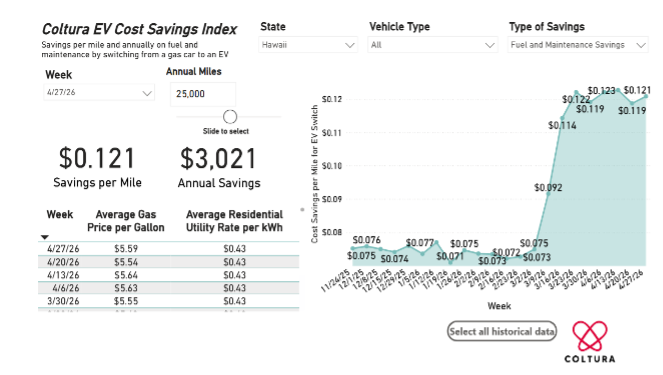
The tool allows you to enter your numbers, including annual mileage, vehicle type, and savings type (fuel or fuel and maintenance), to arrive at a personalized savings figure. The savings estimate is based on recent gas and energy prices. Gas prices are updated about once a week.
A driver putting 15,000 miles a year on their car saves more than $1,800 annually by switching to an EV. A higher-mileage driver at 25,000 miles saves $3,000. At our current gas prices, switching to an EV saves about 12 cents per mile driven.
Learn How Much You Can Save
Run your numbers. If they don't make the case for switching, the tool will tell you that. If they do, you'll know exactly what you're walking away from every month you keep buying gas.
Check out the tool here: data.coltura.org/ev-savings-index
Beyond Annual Savings...
Ownership savings compound over the vehicle ownership period. Since ownership is roughly 8-10 years (my guess), the overall cost-of-ownership benefit can be well over $10,000.
Pricing predictability has value for households and businesses. Gas prices will remain volatile, as they are subject to global oil supply and demand dynamics. Electricity rates are also affected by oil price changes, but they respond more slowly and are less volatile.
Vehicle maintenance gap widens for older vehicles. EVs have fewer moving parts, don't require regular oil changes or transmission service, and have extended brake life due to regenerative braking. In year one, the maintenance difference is minimal, but by year eight, maintenance costs differ significantly.
Learn more about Coltura here.
Drive Electric. Save.
Noel Morin - Hawaii EV