Inside Ford’s EV “Skunk Works”: What It Means for the Future of Electric Vehicles
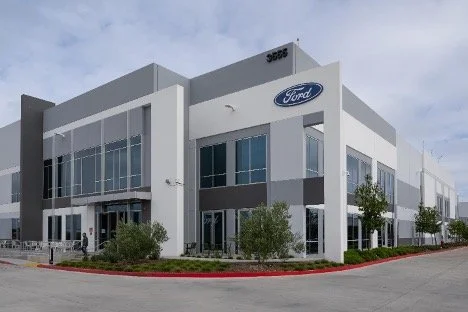
On April 29, I had the opportunity to visit Ford Motor Company’s Electric Vehicle Development Center in Long Beach, California. Yes, we saw a heavily camouflaged future EV pickup, but the more important story was not the truck itself. It was the way Ford is rethinking EV design, testing, wiring, assembly, and eventual repair.
The controlled-access tour took us through a working facility that is still being fleshed out, with plenty of room for expansion. Our visit covered multiple areas, including unicasting, fabrication, the dynamometer chamber, the battery lab, design, trim shop, the (wiring) harness lab, high voltage, and more. As you might expect, cameras were not allowed as this is a working facility.
Yes, we did see a heavily camouflaged midsize electric pickup. More on that later, but the bigger story was the system Ford is building around it.
We gained a fair glimpse of how Ford plans to approach the challenges facing BEV manufacturing and the challenge of competing with highly talented, technically advanced foreign competitors. The short version: this isn’t just about a new electric truck. It’s about rethinking how vehicles are designed, built, and tested.
A Different Kind of Car Factory

The EVDC feels very different from what you might expect from a traditional automaker. The reception area, for example, had a poster outlining Ford’s principles for approaching work in the EVDC. Typical window dressing? Not quite.
The twelve rules are best described by one of them, “Fail Fast,” from which “Learn Fast” follows. Each of the 12 guidelines focused on efficiency, dispensing with sacred cows, and taking responsibility for problems, whether they’re in your area of expertise or not.
Instead of isolated, siloed departments with long timelines, everything is co-located within the two Skunk Works buildings. Open office space and floor plans, in fact, encourage a quick meeting. Engineers, Designers, Testing, Manufacturing? They’re all in the same building. That means fewer formal meetings and more real-time problem solving. If something doesn’t work, the people who can fix it are often just a short walk away. Calling Dearborn for routine matters or routine problem-solving isn’t a thing.
The overall vibe is much closer to a startup than you’d expect from a 120+ year-old company.
From Tradition to Assembly Tree
One of our first stops introduced us to Ford’s assembly tree version of unboxed modular assembly. Instead of traditional sequential assembly line techniques found on Ford’s Mach-E, Ford is embracing modular assembly, or the assembly tree, for their next generation electric vehicles. The basic question the engineers seem to be asking is whether each step in the assembly process can justify itself.
What we saw during this stop was a mockup of a pickup in three sections: rear, mid, and front. The mid-section included the battery pack and the car floor with attached seats. Instead of a separate assembly for each component, these three sections are built separately and then married at the end. The mid-section would slide cleanly into the rear; the front would then attach to the mid-section. Ultimately, the goal appears to be to commoditize these parts. The appropriate sections would be joined, then a VIN assigned, rather than early on.
There are issues, of course. What happens if one of the three assembly lines shuts down? Do the others keep running? Do they stockpile the 2 remaining sections and wait for the missing section? Do they shut down all 3 assembly lines? The hard part, of course, is synchronizing those parallel assembly processes without creating new bottlenecks.
For an electric vehicle, the process could go even further. Instead of the battery pack as part of the midsection floor assembly, for example, the battery pack could be the floor. Will that happen? Whether Ford goes that far in the first production version remains to be seen.
Assembly tree production techniques should result in significantly faster assembly, significantly fewer workstations, and greatly reduced part counts through Unicasting. There is no set gold standard technique yet.
Unicasting & Repairability
The new midsize EV truck is on track to be Ford’s first vehicle made using unicast structural parts (Giga Casting, in Tesla speak). Pioneered by Tesla with the Model Y in 2020, unicasting is rapidly becoming the norm for EVs.
The upside? Reduced part count, lower total weight, lower costs, and lower complexity. Downside? Large aluminum parts can make repairs more difficult. To that end, the plan is to design repairability into unicast parts by using features like predefined cut lines (think ‘cut on the dotted line’), where repair shops can slice out damaged sections and then rivet or glue a repair in place, rather than requiring aluminum welding. Coupled with new structural adhesives for cold repairs, unicast repairs could come down in price even further.
Pay No Attention!
The big tease occurred in the design room. Three covered vehicles sat in the design room. The covers were intentionally placed to hide most details, so anything beyond “interesting” is speculation.
While the theme was present at all stops, the “The best part is no part” goal was first explicitly stated in the Design Studio. Reducing complexity and simplifying design, when possible, means fewer parts, resulting in less waste, lower costs, lower weight, and faster assembly. Very much a “Legacy parts and processes don’t get tenure” mindset.
The Dynamometer Chamber
New to Ford’s Skunk Works is their environmental dyno. Like a treadmill for cars, this isn’t just for simulating EPA range tests. This dyno can simulate climbs, descents, high and low humidity, high vehicle gross weights, wind, and temperatures from -40C to 60C or more. In addition, the dyno incorporates a DCFC unit, where fast-charging capabilities are tested after the car is put through its paces. The past practice of requiring prototypes to be physically tested under extreme conditions may become much rarer.
High Voltage Lab
The highlight here was the Ebox. The Ebox handles almost all things electrical. It will be part of the battery pack and handle most functions essential to EV operation, replacing multiple modules in the process. It can properly route high-voltage power from the High Voltage Battery to the inverters, which supply the motors. It routes both DC and AC from the NACS port to the appropriate locations. The EBox also handles vehicle-to-load and vehicle-to-home tasks. Concerned about heat effects on the Ebox? It is undergoing high-temperature testing.
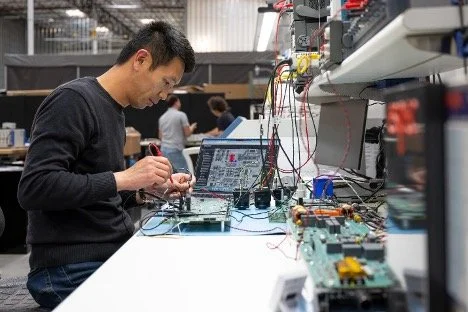
The one thing we never got a straight answer on was whether the upcoming EV truck would be 48V or 12V.
Thermal Lab
Think air-conditioning and heating. The thermal lab was testing heat pumps. The heat pump on display has 4 zonal architecture ports, apparently designed to ensure shorter liquid runs, thereby reducing the required liquid volume. The goal is to delete the backup resistive heating found on most heat pump-equipped vehicles by using a hot-gas bypass to heat both the high-voltage battery and the cabin. The engineers are confident they will successfully eliminate resistive heating.
This is where we saw a zone controller featuring a native NACS port. A native NACS port shouldn’t surprise a soul. Where the final location is on the truck is another question.
Testing the Wiring with the Lab Car
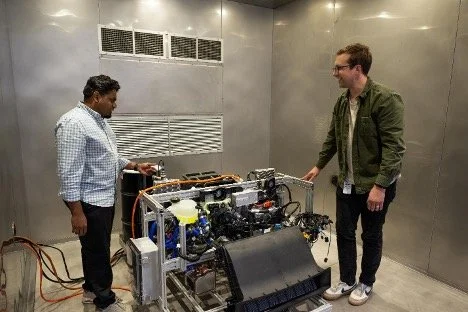
In this case, the lab car was constructed from perforated metal sheets in the form of a pickup truck. Think a 2020s large Erector Set. This allowed us to see the car's wiring harness. While we all knew that Ford had been targeting a reduced-size wiring harness, if what we saw goes into production, the days of bulky wiring harnesses are gone. This was much thinner and smaller overall, 4,000 ft shorter and 22 lbs. lighter.
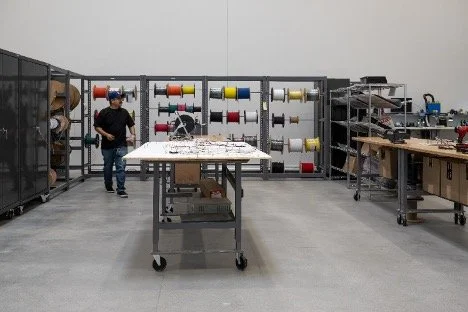
Zonal Architecture
Reducing the amount of wire in Ford’s new EV Truck requires rethinking how the truck functions. Up until now, every device on a Ford vehicle - window motor, seat heater, headlight, etc. - had its own computer module somewhere in the car. Lots of wires connected all those modules. It was complicated and costly. Changing that aligns with the EVDC’s mindset that no process is untouchable.
The EV truck will be Ford’s first production vehicle to feature zonal architecture. Zonal architecture has fewer, more powerful centralized computers, plus a handful of zone controllers for power distribution and data communication. By managing all devices within a specific zone, Ford can reduce the length and number of wires, reduce the number of modules from over 40 in a Mach-E, while lowering the vehicle's total harness weight.
The advantages? Faster, more reliable software updates; features can be added more easily later; lower weight leading to better efficiency and range; and should make issues easier to diagnose and fix.
Prototypes
Ford is currently building 100 prototypes of the new EV truck, which will soon be on the road. That number suggests they’re trying to reduce early-adopter issues by conducting more testing and making changes before finalizing the design.
The Truck
While the tour was supposed to feature no new vehicles, and we all would’ve been satisfied without seeing the EV truck, we did get a glimpse of a highly camouflaged midsize pickup driving into the fleet center. What we saw:
The vehicle is bigger than a Maverick, but smaller than a Ranger.
Visually, in the midsize category, though any precise comparison from a brief, camouflaged sighting would be guesswork.
It is a pickup. It's truck-based, not passenger-car-based like a modern Ford Ranchero.
Bed length was difficult to judge, but clearly not full-size territory. It is, of course, built on Ford’s Universal Electric Vehicle platform.
As for its name? Who knows. We’ll find out next year.
Why This Matters (Especially for EV Adoption)
For a group like the Hawaii EV Association, the bigger story isn’t just one vehicle; it’s what this approach could mean for EVs overall.
If this model works, it could lead to more affordable EVs (through simpler, more efficient design and manufacturing), faster updates and improvements, increased reliability at launch, and potentially a faster response to real-world feedback.
In other words, fewer growing pains and more confidence for everyday drivers, not just enthusiasts.
Final Thoughts
The EVDC represents a shift in mindset as much as a shift in technology.
Instead of cobbling new ideas onto old systems, this approach is about simplifying from the ground up, responding faster, and testing more thoroughly. Every step must justify itself.
Whether that fully succeeds remains to be seen - but the intent is clear. Ford will face hurdles before the new truck begins production sometime in 2027. The design is likely quite far from being finalized. But the fact that they’re moving forward with a startup-with-assets mentality is encouraging. Whether these changes will carry over to Ford’s gas-powered vehicles remains to be seen. Institutional resistance is a real thing.
But if it works - and it can - it won’t just shape one truck; it could influence how the next generation of EVs is designed and built, providing serious competition and potentially reshaping them.
Contributor Bill Greentree is a Big Island EV Ambassador. Bill is a retired international airline pilot and a long-time Hawaii Island resident. He is an early adopter of Ford’s Mach-E and an active EV advocate.