Let’s Revisit EV Shipping Policies
What the Fire Data Actually Says About EVs and Shipping
On July 14, 2025, Matson, Inc., Hawaiʻi’s largest ocean cargo carrier, suspended all shipments of battery electric vehicles and plug-in hybrids across its entire network. In response to that news, we shared information regarding the EV fire risk and mitigation strategies.
Eight months later, most EVs still can’t be shipped on Matson. While some new EVs may already be shipped, the ban still affects many EVs, and all used EVs remain banned. EV owners and would-be owners are living with the consequences.
The reason for the shipping ban was fire risk. The sinking of the Morning Midas on June 23, 2025, where smoke was first observed from a deck carrying electric vehicles, raised concerns across the maritime industry. But what does the fire data actually say? We researched the question, analyzing data from government agencies, marine insurers, automaker records, and peer-reviewed research. The findings deserve your attention.
Fire Risk
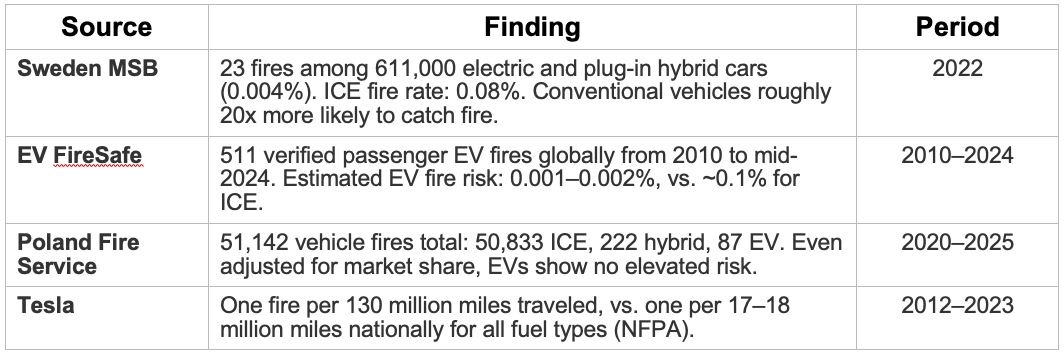
EVs pose lower fire risk than conventional vehicles. This is well supported by credible, independent datasets. The pattern across these datasets is consistent: battery electric vehicles catch fire significantly less often than internal combustion vehicles. The disparity ranges from 20 to 100 times fewer fires per registered vehicle.
A widely shared comparison claiming specific fire rates of 25 per 100,000 for EVs (1,530 for gasoline vehicles and 3,475 for hybrids) has been attributed to “NTSB data.” This claim is false. Car and Driver investigated in 2022 and reported that an NTSB spokesperson stated: “There is no NTSB database that tracks highway vehicle fires.” NHTSA confirmed it does not collect fire data by powertrain type either. Those specific numbers, which originated with AutoInsuranceEZ, are unverifiable and should not be used in policy arguments.
“not more dangerous,… just different.”
EV fires, while rare, do present important challenges. Lithium-ion battery fires can burn hotter, resist standard suppression approaches, and can reignite. This makes individual incidents more resource-intensive for responders and more dramatic on the evening news.
Andrew Klock, senior manager at the National Fire Protection Association, put it well: EVs are “not more dangerous. They’re just different.”
The critical distinction is between frequency and consequence. EV fires are rare but complex. Gasoline vehicle fires are common but treated as routine. Matson’s policy addresses consequences while ignoring the frequency. It is banning the lowest-fire-frequency vehicles while continuing to ship the highest.
What About Shipping Risk?
Maritime transport introduces conditions that contribute to risk. They include vibration from wave action, temperature cycles during transport, salt air, and the long, multi-day transit period. These are legitimate considerations, and they are addressed by the UN 38.3 transport safety certification that all EV traction batteries must pass before shipment. But several facts are worth noting.
The International Union of Marine Insurance stated in September 2023 that “no fire onboard a ro-ro [roll-on, roll-off car carrier] or PCTC [Pure Car and Truck Carrier] has been proven to have been caused by a factory-new EV.” That’s a significant statement from the organization that insures these vessels.
The Morning Midas was not a Matson vessel and was not on a Hawaiʻi route. Additionally, the cause of the fire has not been determined. While smoke was coming from the EV deck, no investigation has conclusively determined that the ignition was caused by an EV battery.
Matson itself has confirmed it has experienced no EV fire incidents aboard its own vessels serving Hawaiʻi.
Impact on Hawaiʻi
With Matson’s restriction, Pasha Hawaiʻi is the only practical carrier for shipping EVs to and from the mainland. Pasha’s MV Jean Anne operates biweekly from San Diego, and the MV Marjorie C provides weekly RoRo service via San Diego, Long Beach, and Honolulu. This combined schedule was designed as a competitive alternative to Matson, not as the sole carrier for all EV traffic.
The consequences of the restriction are impactful:
Shipping delays. Tesla owners in Hawaiʻi report multi-month delivery delays and reassigned VINs due to shipping constraints.
Difficulty shipping used EVs. Residents cannot ship personal electric vehicles to or from the mainland via Matson. This affects military families on PCS orders, college students, retirees relocating, and anyone who purchased an EV expecting normal shipping.
EV adoption. As of January 2026, Hawaiʻi had 40,855 registered EVs, a 13.8% year-over-year increase, representing 3.8% of all registered passenger vehicles. EVs represented 11.1% of new vehicle registrations statewide in Q1 2025, per the Alliance for Automotive Innovation. A shipping bottleneck works against that progress.
What Can Be Done
Pasha demonstrates that safe EV ocean transport is achievable today. They require EVs to maintain a state of charge between 20% and 50% during transit. They’ve transported EVs to Hawaiʻi for years without incident.
Matson had already developed safety protocols before the ban, including thermal imaging cameras, the Viking HydroPen suppression tool, and lithium battery handling procedures. The company’s own preparedness investments show that safe EV transport on container vessels is possible.
Matson partially lifted the ban in October 2025, accepting select new EVs with Lithium-Iron-Phosphate (LFP) batteries on a case-by-case basis. This policy applies across Matson’s entire network, including Hawaiʻi. Reporting from the Guam Daily Post confirms that the models approved so far resulted from documentation work manufacturers completed in Hawaiʻi. But most major brands have not yet submitted the required paperwork. A Guam dealer told the Post that several of its brands, except Volvo, had not yet provided Matson the required documents. Used EVs remain entirely banned, and Matson’s public FAQ page still reads as though the full suspension is in effect.
This means that the bottleneck has shifted. It is no longer a blanket Matson ban. It is a stalled OEM approval pipeline. Matson’s current policy favors LFP battery chemistry, used in some Tesla Model 3 and Model Y vehicles, Chevy Bolt, Ford Mach-E Standard Range, Rivian R1T/R1S Standard Range. However, many of Hawaiʻi’s best-selling EVs remain restricted. That pipeline needs to move faster, and Hawaiʻi’s EV community, dealers, and policymakers should be pushing manufacturers to submit their documentation. The partial resumption confirms that Matson can safely ship EVs. The question is why so few models have been approved eight months later.
The data is clear. EVs are, by every credible measure, the lowest-fire-risk vehicle category on the road. Hawaiʻi’s clean transportation future shouldn’t be held up by policies that don’t match the evidence.
Here are a couple of constructive paths forward:
Accelerate Matson’s model-by-model approval process by encouraging OEMs to submit battery safety documentation. Many major manufacturers have not yet submitted the required paperwork. This could increase the number of models that Matson can carry.
Expand the scope of the Hawaiʻi State Energy Office’s Act 209 Working Group (Electric Vehicle Battery Recycling and Reuse Working Group) to include ocean transport safety in its scope. This may provide more realistic risk data to inform the policy regarding all EVs, including used ones.
What You Can Do
Share your story. If the shipping restrictions have affected you personally, whether through delivery delays, an inability to ship a used EV, or unexpected costs, we want to hear from you. Email us at info@hawaiiev.org.
Stay informed. We’ll publish updates as this issue develops. Subscribe to our newsletter and follow us on social media.
Sources
Swedish Civil Contingencies Agency (MSB), 2022 vehicle fire data https://rib.msb.se/filer/pdf/29438.pdf (Swedish-language PDF covering 2018–2024. English-language summary available IEEE Spectrum - https://spectrum.ieee.org/lithium-ion-battery-fires)
EV FireSafe, Global EV Fire Tracker (2010–2024) https://www.evfiresafe.com/ev-fire-key-findingshttps://www.evfiresafe.com/ev-battery-fire-data
International Council on Clean Transportation, "Clearing the air: Emerging data and battery trends suggest EVs could bring lower fire risk," October 2024 https://theicct.org/clearing-the-air-evs-could-bring-lower-fire-risk-oct24/(Note: the actual ICCT title is slightly different from what we had in the documents. The correct title is "Clearing the air," not "Separating fact from fiction.")
IUMI press release, September 10, 2023 https://iumi.com/news/press-release/ocean-transport-of-lithium-ion-batteries-in-electric-vehicles/
Plug In America, "The facts about EV fire safety," September 2025 https://pluginamerica.org/the-facts-about-ev-fire-safety/
National Fire Protection Association, "Vehicle Fires" https://www.nfpa.org/education-and-research/research/nfpa-research/fire-statistical-reports/vehicle-fires
Car and Driver, "No, Millions of Cars Are Not Catching Fire Every Year" June 2022 https://www.caranddriver.com/research/a41100099/are-electric-cars-more-likely-to-catch-fire/
Hawaii Public Radio, "Matson stops shipping electric vehicles to Hawaiʻi," July 18, 2025 https://www.hawaiipublicradio.org/local-news/2025-07-18/matson-stops-shipping-electric-vehicles-to-hawaii
Allianz Commercial, Safety and Shipping Review 2025 https://commercial.allianz.com/content/dam/onemarketing/commercial/commercial/reports/commercial-safety-shipping-review-2025.pdf
Disclosure: AI language tools were used to assist with research synthesis and drafting of this post. All data sourced from publicly available information and verified against primary sources. The author reviewed, edited, and takes full responsibility for all content and conclusions. Despite rigorous fact-checking, errors may remain. If you spot one, please email info@hawaiiev.org. We will issue corrections promptly and transparently.